


I still remember my first view of McAllen: endless fast-food signs, motorized scooters at a mall entrance, and a city that seemed designed to keep people inside cars and in front of screens. I decided to spend a day living the local routine—tasting the food, counting calories, and listening to residents and experts—to try to make sense of why McAllen obesity rates sit so high on national rankings.
1) First Impressions: A City Built for Convenience — and Calories
This is McAllen, the most obese city in the world.
That line played in my head as I drove in. Within minutes, the landscape explained why the label sticks. I passed 10 fast-food outlets in two minutes. Not a cluster, not a coincidence—more like a planned strip of drive-thrus and big signs. It didn’t feel like normal city growth. It felt like a fast-food corridor, where the easiest choice is always the next meal.
Fast food prevalence you can’t ignore
The Fast food prevalence here is not subtle. Restaurants repeat block after block, and the spacing matters: when food is always two turns away, cooking at home has to compete with pure convenience. Locals told me people order fast food as often as three times a day, and the portions can be extreme—one “common” meal can hit 2,250 calories. The city’s first impression is that calories are built into the routine.
Walking looks impractical by design
During a 20-minute drive, I didn’t see anyone jogging, biking, or even walking with purpose. The streets told me why. Sidewalks were rare. Safe crossings were even rarer. Bike lanes were basically absent. Add the heat and the lack of shade, and walking starts to look less like a choice and more like a risk. In a place where “walking is impossible,” it’s easier to stay in the car for everything.
This matters because McAllen is often cited for having one of the highest shares of Physically inactive adults in the country. When the environment doesn’t support movement, inactivity becomes the default setting.
Soda demand at industrial scale
Another detail stood out: the city’s relationship with sugary drinks. I learned that many residents drink huge amounts of soda each year instead of water, and demand is so high that Coca-Cola operates a massive distribution center here. Seeing that kind of infrastructure made the habit feel normalized—like soda isn’t an occasional treat, but a daily staple.
A mall entrance that signals low mobility
At a local mall, the message was immediate. Right at the entrance were motorized scooters, lined up and ready. Some were already taken, and it was early in the morning. The setup suggested an expectation: many shoppers don’t plan to walk far, even indoors. It wasn’t framed as unusual—it was just part of how the space works.
Scooters at the door reduce the need to walk from the start.
Food options everywhere make eating the easiest activity inside.
McAllen obesity rates feel visible in everyday life
As I moved through stores and parking lots, the visual prevalence of obesity was immediate—large waistlines, slow steps, people struggling to carry their own weight. With McAllen obesity rates reported around 45% of adults classified as obese, the numbers didn’t feel abstract. This opening snapshot made it clear: in McAllen, the environment and the culture often push in the same direction—toward convenience, and toward calories.
2) Fast-Food Density & Portion Culture: How Accessibility Shapes Eating
Fast food prevalence in the McAllen fattest city
When I looked at daily life in McAllen, the first thing that stood out was how easy it is to eat fast food all day. McAllen is a small, low-income Texas city near the Mexican border with about 150,000 people, yet it has over 500 fast-food establishments. That density is nearly six times the U.S. average. In the Most obese city America conversation, this kind of access matters because it turns high-calorie food into the default choice—quick, cheap, and everywhere.
I heard locals talk about grabbing fast food up to three times a day, and it’s not hard to see why. A “normal” combo can quietly become a full day’s worth of energy.
Common order | Calories |
|---|---|
Large Coke + fries + triple-patty burger | 2,250 |
Portion culture: oversized plates meet “don’t waste food”
McAllen sits between two food cultures. America is known for oversized portions, while in Mexico, wasting food is often seen as inappropriate. Here, those ideas can combine in a risky way: people try to finish huge portions even when they’re already full. A local dietitian, Brandon, told me the most common issue he sees is simple but powerful.
Knowing how many calories are in the food you're eating.
Right after that, he pointed to the next problem: knowing portion sizes. When big servings feel normal, overeating stops feeling like overeating. Brandon even mentioned people who eat over 10,000 calories a day.
Even “traditional” foods are getting heavier
Another pattern I noticed is that traditional dishes don’t always stay traditional. Many have been turned into higher-calorie meals, often loaded with cheese and fried ingredients. That shift matters for kids and teens too. Research often links obesity to early habits, and McAllen has a high share of obese teenagers and children—so what’s “normal” now can shape health for years.
Snacks, bakeries, and drinks that don’t look like meals
In stores, energy-dense snacks like chips and sugary drinks are hard to miss. And in bakeries, I noticed something small but important: no calorie counts on many items. One cookie can be around 500 calories; three cookies is about 1,500.
Drinks can be just as intense. I saw an indulgent coffee shop drink listed at 920 calories—close to half of a recommended day for many people—yet it’s marketed like a simple treat.
3) Sugar, Drinks, and the Physiology of Overeating
McAllen obesity rates start with what’s in the cup
In McAllen, the food culture isn’t only about burgers and fries. It’s also about what people drink all day. Locals talk about soda like it’s a normal daily staple, and many residents drink hundreds of liters of Coke each year. That demand is big enough to support a major distribution hub, which says a lot about how constant the supply is. When sugar is everywhere and cheap, it becomes the default.
My “coffee breakfast” was basically dessert
To understand the routine, I ate like a typical local for a day. I started with a 390-calorie coffee drink. When I asked if people see it as dessert or coffee, the answer was simple: coffee. The portion didn’t even feel “too large,” which shows how normal high-calorie drinks have become.
I started the day with very sugary meals, my insulin spiked and then crashed.
About an hour later, I felt it: a heavy crash and a strong pull to eat again. That’s the physiology of overeating in real time.
How sugar pushes hunger: spike → crash → repeat
Here’s the basic loop I experienced:
Sugar hits fast (especially in liquid form).
Insulin rises to move sugar out of the blood.
Energy drops after the spike.
Hunger returns quickly, even if I already had plenty of calories.
This cycle helps explain why pastries + sugary coffee can turn into fast food only a few hours later. It’s not just “no willpower.” It’s a predictable body response.
33 sugar cubes in one drink
Later, I saw how extreme the numbers can get. One drink in my day was described as equal to 33 sugar cubes. Another example was a 920-calorie drink—calories that don’t make you feel full the way solid food does. In the bigger meals, beverages alone can add up fast, including around 110 grams of sugar across drinks.
Visceral fat, Diabetes heart disease, and Obese teenagers children
Repeated sugar overload doesn’t just add weight; it feeds visceral fat, the deep belly fat linked to metabolic disease. That matters in a city where the health outcomes are already severe: McAllen ranks with the 8th-highest adult diabetes percentage and the 4th-highest heart disease rate nationally. These risks start early too—promotions aimed at families help normalize sweet drinks for Obese teenagers children, and childhood fat cells can persist and keep sending hunger signals later.
“Healthy” juice and confusing labels
Even drinks marketed as better choices can be sugar traps. Some processed fruit juices contain 39g added sugar per 12 oz serving. Add bright packaging, “no added sugar” claims on other products, and constant fast-food marketing, and it becomes easy to drink a day’s worth of sugar without realizing it.
4) Built Environment: Why Walking Feels Impossible
In McAllen, I kept hearing about food—some people eating 10,000 calories a day—but the other half of the story is movement. The city itself makes daily activity feel optional, even inconvenient. As one person put it plainly:
This city is built for cars.
Car-first streets shrink Physical activity opportunities
Most things people need aren’t clustered in a walkable center. Homes, stores, jobs, and restaurants are spread out, and the roads between them are designed for speed and traffic flow, not for pedestrians. Sidewalks can be missing, crossings feel far apart, and bike lanes are rare. That design choice quietly shapes how much people move without thinking about it—walking to a store, biking to a friend’s house, or even taking a safe evening stroll.
Two hours on foot, 20 minutes by car
The distance problem is real. I heard that if you leave your house and try to walk to many common places, it can take about two hours. By car, it’s still around 20 minutes. When the built environment rewards driving that strongly, walking stops being a normal option and starts feeling like a workout you must schedule.
Even small goals can feel out of reach. Someone told me they tried to walk a mile—about 2,000 steps. That’s far below the often-cited 10,000 steps recommended for a healthy adult, but hitting that number is tough when errands require a car and “incidental steps” don’t happen.
Why so many Physically inactive adults report low daily exercise
Another detail that stuck with me: the average person here may spend less than 20 minutes a day exercising. Pair that with high-calorie eating and the math becomes brutal. It’s not only about motivation; it’s about a daily routine built around sitting—driving to work, driving to eat, driving back home.
Heat, humidity, and the missing comfort of Parks recreational facilities
Even when people want to be outside, the weather pushes back. With heat and humidity near 90°F much of the year, outdoor activity can feel draining or unsafe, especially for beginners. Parks exist, but access is a major issue. Research insights show McAllen ranks among the lowest in the country for residents with easy access to Parks recreational facilities. If the nearest park is far, and the walk there is unpleasant, it’s easy to skip.
Gym fees become a “movement tax”
Staying active often means paying for it. Gyms may be affordable, but they still feel like an extra monthly bill many households avoid. In a city where driving is the default and fast food is everywhere, choosing exercise can feel like adding cost and effort to a day that already runs on convenience.

5) Money, Marketing, and the Illusion of ‘Healthy’ Food
Fast food prevalence meets tight budgets
My morning in McAllen started with a “quick wake-me-up” coffee that was 390 calories. When I asked if people see it as dessert or coffee, the answer was simple: coffee. Portion size didn’t seem “too large,” either. That set the tone for how calories can hide in plain sight.
By 9:30, the breakfast place was packed. The buttery smell hit me at the door, and the menu had endless ways to “get fat or get unhealthy.” The most local pick? Big chocolate pancakes with butter and syrup. My plate came out as scrambled eggs with American cheese, bacon, and two chocolate chip pancakes—each with butter. It tasted like a treat, but it was framed as normal breakfast. The total: 1,100–1,200 calories.
Socioeconomic challenges access: when “healthy” costs more
Later, I did a quick price check that made the problem feel less like willpower and more like math. A container of fresh fruit rang up around $16, while a triple meat burger meal came in at under $12. If you’re trying to stretch a paycheck, the cheaper option also happens to be the most filling—and usually the most processed.
That matters here because McAllen residents earn about 30% less than the U.S. average. In that context, Healthy food options can feel like a luxury category, not a daily choice.
Marketing turns ultra-processed into “healthy”
In stores, I kept seeing ultra-processed products dressed up with health language—phrases like “supports heart health” or “lower cholesterol”, plus vitamin callouts and heart icons. The front of the box suggests protection, while the ingredients often lean on added sugar, refined starches, and oils that can increase long-term risk when eaten often.
“No byproducts” labels that still don’t explain mechanically separated meat.
“Fortified” cereals that look healthy but can be corn syrup-laden sweetness.
Bright packaging that makes sugary snacks feel harmless and routine.
Kids’ promos and default meals
Family deals push habits early—“kids eat free” signs, cartoon tie-ins, and combo meals that make fries and soda feel like the standard. I even noticed foam plates printed with a burger-and-fries image, like a template for what a meal is supposed to be. That kind of visual marketing normalizes the same choices day after day.
The real price tag
After breakfast, I saw snack displays and wondered why anyone would need junk food two hours after eating. Then we stopped at a bakery with no calorie counts. A single cookie can hit 500 calories, and three can reach 1,500. These patterns don’t just affect individuals—obesity-related medical treatments cost the U.S. an estimated $190.2 billion each year.
I think it's because we have a lot of good food here.
6) Personal Stories: When Eating Becomes an Escape and a Prison
Health weight status, up close
Before I even tried to total up calories for the day, I wanted to see what life can look like years later for someone who eats like this every single day. That’s how I ended up meeting an obese man who is now trapped in his own body. To protect his privacy, his face was blurred and his identity fully concealed, even though he chose to share his story.
He told me the last time he was weighed, he was between 745–765 lbs. He’s 5’8”. His current weight is unknown because he now lives entirely in bed.
From drugs to food: dopamine-seeking in real time
He described a past drug habit that lasted for years. Cannabis can trigger strong food cravings, and even after he quit, he said his brain still chased that same reward feeling. Food became the substitute. What hit me hardest was how clearly he could name the cycle: eating wasn’t fixing the pain, but it was still the tool he reached for.
“I would eat. And I would get full. But my mind would tell me it was good, keep going.”
10,000 calories and the app trap (Obese adults rate reality)
When I asked about a typical day, he estimated around 10,000 calories. He listed meals like multiple sandwiches, a full combo, cookies, nuggets, and large fries—then still ate the meals provided where he was staying. He told me he became obsessed with getting more food, even when he couldn’t afford it.
He explained how he manipulated delivery apps by making false complaints to trigger refunds or replacement orders:
Calling customer service and lying about the driver
Claiming the bag was dirty so he “couldn’t touch it”
Getting the same large meal redelivered or refunded, then ordering again elsewhere
Bedridden life and Obesity medical costs
His daily routine showed the real price of extreme weight: an oxygen machine to help him breathe, a bag full of medications he takes every day, and a bedpan he cleans regularly. His sleep schedule was flipped—bed around midnight, then waking up close to 6:00 PM. He said when you’re always lying down, your body stops giving clear signals for sleep and wake.
Why this story matters beyond one room
He told me that in nine months he became unable to stand, and in one year he gained about 200 lbs. It’s an extreme case, but it connects to bigger patterns: four out of 10 children are overweight nationally, and many become part of the obese adults rate later. Fat cells formed in childhood can persist and influence hunger signaling for life. Add addiction, mental health strain, and an environment built for constant ordering, and “health weight status” stops being a chart and starts being a cage.
7) I Ate Like a Local: A Calorie Diary (and Regrets)
McAllen has the highest McAllen obesity percentage I kept seeing in reports: about 45% of adults are classified as obese. Numbers like that can feel abstract, so I tried something simple: I spent one day eating the way many locals around me were eating. I tracked calories, watched how I felt, and thought about what this does to Body mass index over time.
9:30 AM: The “Breakfast” Coffee (390 calories)
I started the day with a 390-calorie coffee for breakfast.
It wasn’t a small black coffee. It was sweet, creamy, and felt halfway between a drink and a dessert. When I asked if the portion was “large,” the answer was basically: not really. That set the tone—high calories can show up in normal-looking cups.
Breakfast: Pancakes, Butter, Syrup (1,100–1,200 calories)
By the time I sat down for a real breakfast, the place was packed. The smell of butter hit immediately. The “most local” suggestion was big chocolate chip pancakes with butter and syrup, plus scrambled eggs with American cheese and bacon. The total estimate: 1,100–1,200 calories. It tasted great, but it also felt like dessert pretending to be breakfast.
Two Hours Later: Bakery “Snacks” (500–1,500 calories)
Right after paying, there were snacks everywhere. Then we went to a bakery—no calorie counts posted. Cookies, glazed donuts, cream-filled buns lined up like everyday choices. One cookie alone can be ~500 calories. Three cookies? ~1,500 calories, almost a full day’s energy for some people.
Next Door: The 920-Calorie Coffee Shake
Locals often pair pastries with another coffee, so I followed. One popular drink had Oreos, ice cream, whipped cream, chocolate sauce, and espresso shots. It came out to ~920 calories, with sugar compared to 33 sugar cubes. I felt the spike, then the crash—hungry again fast. That cycle helps explain visceral fat buildup, even when meals feel “normal.”
Afternoon: Fast Food Prevalence in Real Time (2,250 calories)
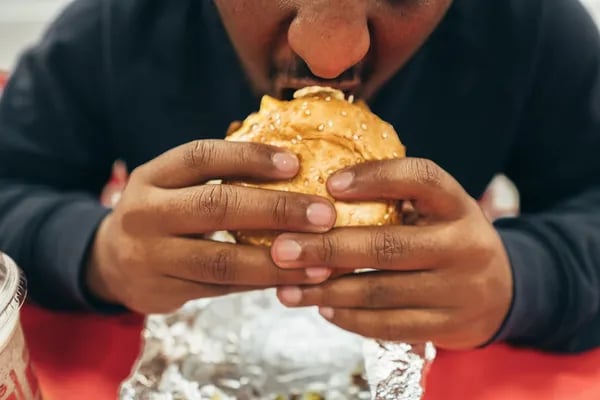
I tested Fast food prevalence by ordering what the customer ahead of me ordered: a large Coke, regular fries, and a triple-patty burger with three slices of cheese. Total: 2,250 calories. The line moved fast, the food was cheap, and the combo was treated as standard.
Dinner at Home: The 7,000-Calorie “Local” Spread (I Couldn’t Finish)
At the store, the shelves were full of “empty calories”—chips, sugary drinks, and juices that were basically flavored sugar water. Dinner was cooked at home, but it wasn’t light: fried chicken, mac & cheese, fries, a large soda, and a massive milkshake (six scoops of ice cream, cookies, heavy cream). The full meal was estimated around 7,000 calories, with the shake alone around 2,250. I couldn’t finish it.
Stop | Estimated calories |
|---|---|
Sweet coffee | 390 |
Pancake breakfast | 1,100–1,200 |
Bakery (3 cookies example) | ~1,500 |
Loaded coffee drink | ~920 |
Fast-food combo | ~2,250 |
Home dinner (extreme example) | ~7,000 |
In the extreme version of this day, the total can push past 10,000 calories. Seeing it meal by meal made the obesity stats feel less like a mystery and more like a routine.
8) What Now? Practical Steps, Policy Ideas, and Strange but Useful Things I Noticed
McAllen story bigger: what the shelves taught me
Walking through McAllen supermarkets, I kept thinking: this isn’t just about “willpower.” The food environment is built for empty calories. Chips are the default snack, and a “small” daily bag can quietly add about 33,000 extra calories a month—roughly 9 pounds of body fat. Drinks are worse. A 12 oz serving with 39 grams of added sugar is “very easy to drink,” and many “fruit” juices felt like flavored sugar water with dyes and almost no real nutrition. Then I saw the price gap that explains so much: $16 fruit sitting in the same city where a triple meat burger meal is under $12. If McAllen residents earn about 30% less than the U.S. average, the math pushes people toward the cheapest calories.
Policy that matches reality (food + streets + income)
WalletHub’s 2025 rankings of the 100 largest metro areas (19 indicators) help because they make the problem visible—these are Mapped overweight cities, not isolated “bad choices.” Texas shows up repeatedly (San Antonio 13th, El Paso 20th), while Honolulu is the least overweight city, which hints that design and access matter. With U.S. obesity-related medical costs around $190.2 billion a year (plus about $4.3 billion in absenteeism), city leaders have a budget argument, not just a moral one.
To me, the best interventions bundle three things: better food access (incentivize full-service grocery stores and produce vendors), better infrastructure (shade, sidewalks, safe crossings, park access), and help for low-income families (vouchers or subsidies so fruit can compete with fast food).
Regulate kid-focused marketing that normalizes junk
I couldn’t ignore how packaging talks to children: bright colors, heart icons, and “vitamins and minerals” claims on ultra-processed cereals. Even “supports heart health” can sit on products that raise risk. I’d start with tighter rules on child-directed ads, clearer front labels, and a rethink of “kids eat free” deals that steer families toward fries and soda as the default.
Climate-aware movement: make activity possible here
Heat and humidity change what “go for a walk” means. I’d fund indoor public gyms, school gyms open after hours, and shaded walking routes that connect neighborhoods to parks. Safe crossings matter as much as treadmills.
Strange but useful: the mall scooter swap
One idea I can’t shake: replace motorized mall scooter rentals with walking incentives—step-count discounts, “active scooter” options, or store rewards for walking loops. It’s small, but Public health campaigns work when they shift what feels normal.
Start small, prove it works, then scale
After watching Chef Nick say,
I absolutely can.
and then build a 7,000-calorie dinner with a 2,250-calorie shake and 110 grams of sugar in one drink, I’m convinced transparency is power. Calorie counts in bakeries, community cooking classes, school food programs, and local trials (like produce vouchers or a modest tax on ultra-processed items) won’t fix everything overnight—but they can change the default settings. That’s how this ends: not with blame, but with better choices made easier.
